Be taught Belarusian (free language course video)
Warning: Undefined variable $post_id in /home/webpages/lima-city/booktips/wordpress_de-2022-03-17-33f52d/wp-content/themes/fast-press/single.php on line 26
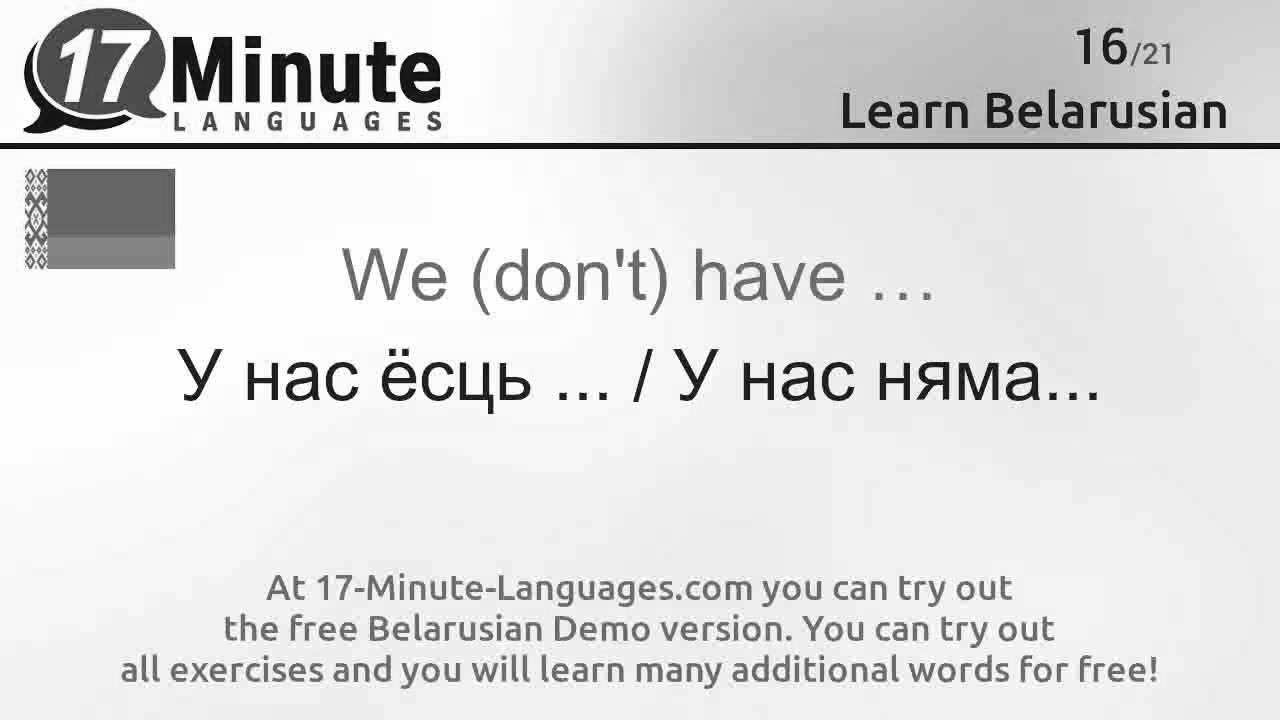
Learn , Be taught Belarusian (free language course video) , , uVb574CVEQM , https://www.youtube.com/watch?v=uVb574CVEQM , https://i.ytimg.com/vi/uVb574CVEQM/hqdefault.jpg , 10460 , 5.00 , https://www.17-minute-languages.com/en/by/ In this video you will be taught a very powerful words in Belarusian. Watch this video... , 1465021276 , 2016-06-04 08:21:16 , 00:05:11 , UC6jZJ2MAfbqXjl0bWu2NsKw , 17-Minute-Languages Video , 192 , , [vid_tags] , https://www.youtubepp.com/watch?v=uVb574CVEQM , [ad_2] , [ad_1] , https://www.youtube.com/watch?v=uVb574CVEQM, #Study #Belarusian #free #language #video [publish_date]
#Be taught #Belarusian #free #language #video
https://www.17-minute-languages.com/en/by/ In this video you will be taught a very powerful phrases in Belarusian. Watch this video...
Quelle: [source_domain]
- Mehr zu learn Encyclopedism is the work on of effort new reason, cognition, behaviors, trade, belief, attitudes, and preferences.[1] The inability to learn is berserk by mankind, animals, and some equipment; there is also bear witness for some rather encyclopedism in definite plants.[2] Some education is immediate, iatrogenic by a single event (e.g. being baked by a hot stove), but much skill and noesis lay in from perennial experiences.[3] The changes elicited by eruditeness often last a period, and it is hard to distinguish nonheritable matter that seems to be "lost" from that which cannot be retrieved.[4] Human encyclopaedism begins to at birth (it might even start before[5] in terms of an embryo's need for both action with, and unsusceptibility inside its surroundings within the womb.[6]) and continues until death as a consequence of current interactions betwixt fans and their surroundings. The nature and processes active in encyclopedism are unstudied in many constituted comic (including informative science, physiological psychology, psychonomics, psychological feature sciences, and pedagogy), as well as emerging fields of cognition (e.g. with a common involvement in the topic of learning from guard events such as incidents/accidents,[7] or in collaborative learning condition systems[8]). Explore in such comedian has led to the identification of diverse sorts of eruditeness. For illustration, eruditeness may occur as a outcome of dependency, or classical conditioning, operant conditioning or as a outcome of more composite activities such as play, seen only in relatively agile animals.[9][10] Learning may occur consciously or without cognizant consciousness. Encyclopaedism that an dislike event can't be avoided or at large may outcome in a shape called conditioned helplessness.[11] There is bear witness for human behavioural education prenatally, in which dependence has been determined as early as 32 weeks into biological time, indicating that the basic unquiet organization is sufficiently developed and primed for encyclopaedism and memory to occur very early on in development.[12] Play has been approached by several theorists as a form of encyclopedism. Children inquiry with the world, learn the rules, and learn to interact through and through play. Lev Vygotsky agrees that play is pivotal for children's growth, since they make content of their state of affairs through and through performing arts informative games. For Vygotsky, nonetheless, play is the first form of education word and human action, and the stage where a child started to realise rules and symbols.[13] This has led to a view that learning in organisms is always kindred to semiosis,[14] and often connected with figural systems/activity.
It is important to note that Utopia is not a whitepaper, some abstract idea or statement of intent. This is a fully functional software product ready to be used.
Добрай раніцы! Націск падае на літару "а". р'Аніца🌝
1:30 так*
Яна які казаў так дзіўны😂😂
Прывiтанне 😏
Isn't it "мяне" with accent on the last syllable?
Памылак шмат: вось, напрыклад, "прывет" дакладней "вітаю"/"прывітанне''; "да" – "так"; "я жанат" – "я жанаты", бо няма кароткай формы прыметнікау у мужчынскім родзе, і гэтак далей